Learning aim
The objective, concept or question the work should focus on.
AI-assisted · human-reviewed · for UK edtech teams
Quillattice supports UK edtech teams with learning content, mathematical data analysis, presentations, visual assets and educational video planning.
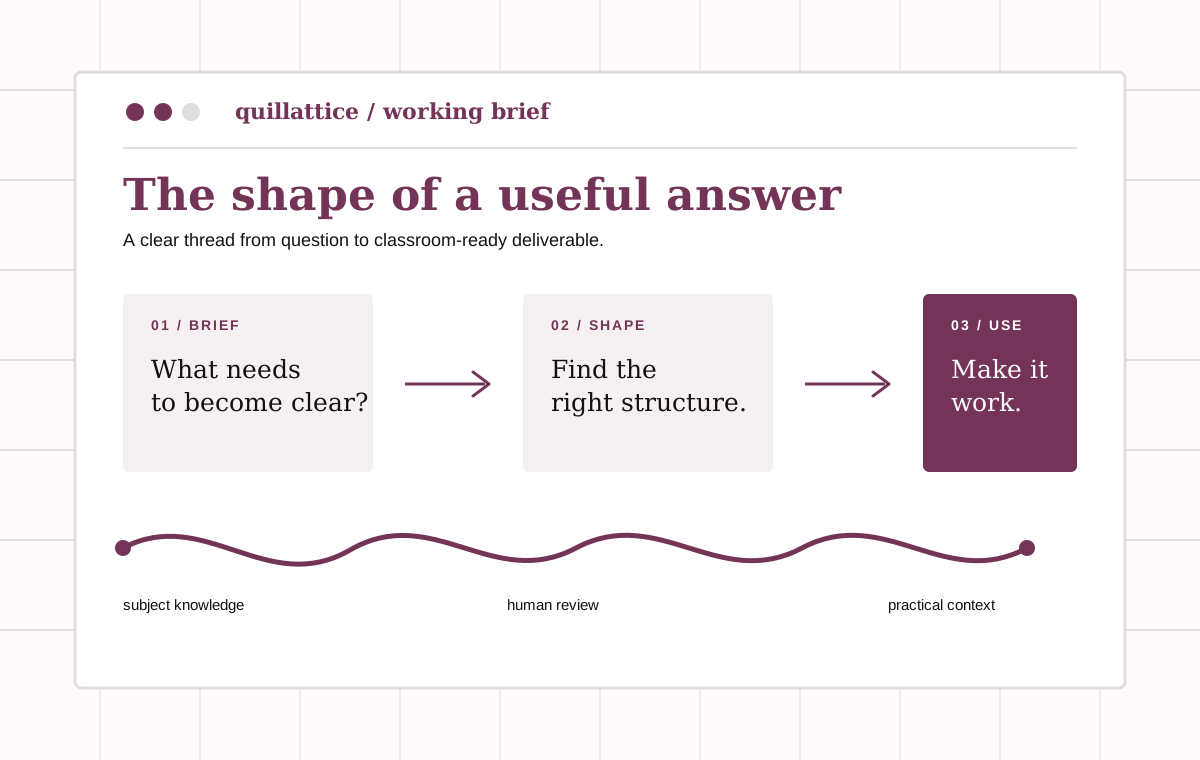
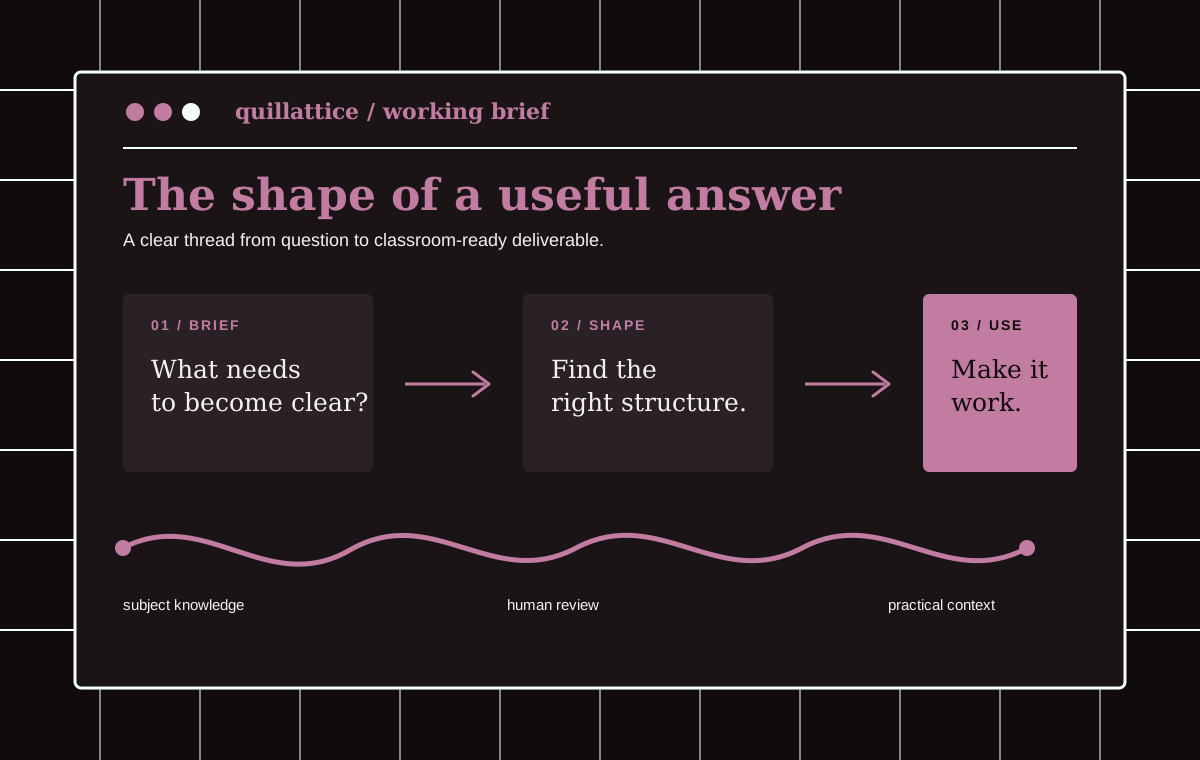
Start with a product question, learning objective or supplied data. Shape the work for the learners, educators or institutions who will use it.
Four ways to support the work
Each service starts with the material and context you supply, then takes the form that best fits the learning or communication task.
LEARNING CONTENT
Shape a learning objective into explanations, questions, worked examples and classroom-ready resources for the intended learners and education context.
Read about learning contentMATHEMATICAL DATA ANALYSIS
Explore supplied assessment, learner or programme data, identify visible patterns and state what the numbers can support. A pattern alone does not prove a cause or outcome.
Read about mathematical data analysisPRESENTATIONS AND VISUAL ASSETS
Shape an education-product, teaching or staff-development message through a clear narrative, slides, diagrams, charts and graphics.
Read about presentations and visual assetsEDUCATIONAL VIDEO PLANNING
Plan concise videos around one learning idea, with scripts, storyboards and supporting materials to guide the sequence.
Read about educational video planningIllustrative insight visual
This small synthetic score set shows how a summary might be presented without implying that it describes a live product, learner group or outcome.
Inspect the full sample portfolioHypothetical fractions check
Synthetic scores only. Five values do not describe a class or show an intervention effect.
A brief with the right context
Share the product or feature, who it is for and what the work needs to help explain, explore or communicate.
The objective, concept or question the work should focus on.
The learners, educators or institutions and the education context they use.
Relevant content, examples, specifications or assessment and programme data.
The deliverable, constraints and review process that fit your product team.
AI-assisted · human-reviewed
AI supports exploration and drafting. Human review, mathematical judgement and classroom context shape the deliverable before it is shared.
The founder holds a BSc in Mathematics from Loughborough University and a PGCE in Mathematical Education from the University of Leicester. He teaches Maths in a secondary school and has experience with higher-attaining pupils, Further Mathematics and UKMT Mathematical Challenges.
A good place to begin
In the project brief, choose “Edtech team” or start with the Edtech team audience template to outline the product, audience and deliverable.